
Key Takeaway: How to Remove Press-on Nails
To remove press-on nails safely, soak your hand in warm water with soap and a little oil for ten to fifteen minutes, then slide the press-ons off from the side. That keeps the set reusable. If the glue won’t budge, pure acetone breaks it down in about ten minutes, but the set is done for good after that.
RELATED: How to Care for Your Natural Nails Between Press-On Sets
Why Proper Press-On Removal Matters
Ripping a press-on off dry takes a layer of your natural nail with it. That’s the whole reason this guide exists.
Your nail is made of layers, like thin sheets stacked on top of each other. Force a press-on off and you peel one of those sheets away, which is why nails go thin, ridged, and weak after a rough removal. Give the glue time to release on its own and none of that happens.
Safe removal takes ten to twenty minutes. That’s not a long time for something that keeps your natural nail intact for the next set.
The Great Debate: Acetone vs. Acetone-Free Removal
Which removal method you use comes down to one question: do you want to wear this set again? That answer decides everything else.
Acetone is a solvent. It dissolves glue and it dissolves the plastic the press-on is made from, which is why it works fast and why it also ends the set for good. Acetone-free methods use warm water and oil to soften the glue instead, which takes longer but leaves the press-on in one piece.
There’s a skin cost too. Acetone strips the natural oils out of your skin and nail plate on the way through. The water-and-oil method does the opposite. It hydrates while it works.
Choose acetone-free if you want to save and reuse the set.
Choose acetone if you’re ready to toss the press-ons and want them off fast.
Method 1: The Acetone-Free Method (Warm Water, Soap, and Oil)
This is the method to use when you want to wear this set again. It’s slower than acetone, but it’s the one that keeps the press-ons intact.
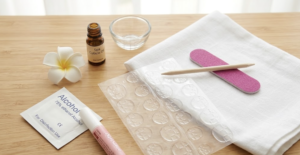
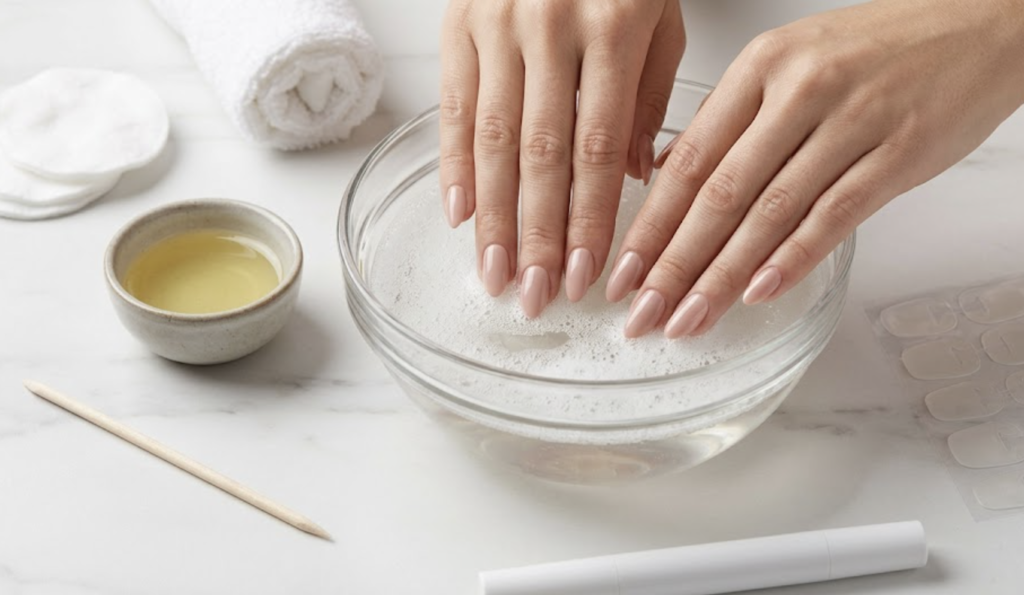
What you need: a bowl of warm water, dish soap or hand soap, cuticle oil or plain olive oil, and a wooden cuticle stick.
- Oil the edges. Rub cuticle oil or olive oil around the sides of each press-on before you start soaking.
- Soak. Warm, soapy water with a splash of oil, ten to fifteen minutes. Top off with hot water if it cools down.
- Nudge, don’t pry. Use the wooden stick at the edge. If it doesn’t move without force, it’s not ready yet. Soak five more minutes.
- Slide from the side. Work it off sideways, never straight up from the tip.
- Floss the stubborn ones. An oil-soaked dental floss pick slides under a lifted edge and finishes off the glue.
If it lifted at the edge but won’t fully release, it needs more soak time, not more pressure. Five more minutes usually does it.
If it’s still stuck after twenty minutes, the glue is stronger than the water can handle on its own. Move that nail to the acetone method.
Method 2: The Acetone Method (For Stubborn Glue and Disposal)
This is the method for glue that won’t cooperate, or for a set you’re ready to be done with. It’s fast, and it’s not gentle.
What you need: 100% pure acetone, not diluted polish remover. Cotton balls, foil, and petroleum jelly.
- Protect your skin. Coat your cuticles and the skin around each nail with petroleum jelly first.
- Wrap or soak. Wrap acetone-soaked cotton on each nail with foil, or dip your fingertips into a small bowl. Ten minutes.
- Wipe, don’t scrape. The plastic will have gone soft, almost gel-like. Wipe it away with a paper towel. If it resists, give it more time instead of more pressure.
Acetone dries your skin out fast. Oil and lotion right after aren’t optional here, they’re the second half of the method.
Quick Comparison: Which Method Should You Use
The short version comes down to reuse and risk. Here’s how the two stack up side by side.
| Warm Water, Soap & Oil | Pure Acetone | |
|---|---|---|
| Best for | Beginners, sensitive skin, sets you want back | Stubborn glue, fast removal, sets you’re done with |
| Nail damage risk | Zero | Low, but drying |
| Reusable after? | Yes | No |
| Time | 10 to 20 minutes | About 10 minutes |
How to Restore Your Natural Nails Post-Removal
Your natural nail is the thing that actually matters once the press-on is off. A few minutes of aftercare handles most of it.
Buff off any leftover glue with a soft buffer block, not a metal file. A file thins the nail. A buffer just clears residue off the top.
Rehydrate right away with cuticle oil and a thick hand cream, especially if you used acetone. Then give your bare nails twenty-four hours before the next set goes on. That’s how long the nail bed needs to settle.
What to Do When a Press-On Nail Pops Off Early
A nail popping off early isn’t a sign you did something wrong. It’s usually one of two fixable things: sizing or a dry nail bed.
The quick fix:
- Wipe both your natural nail and the back of the popped-off nail with rubbing alcohol.
- Lightly buff the natural nail so the glue has something to grip.
- Add a small drop of glue to both surfaces and press for thirty seconds. Count it out loud. Ten feels like thirty when you’re guessing.
Prevention for next time: dehydrating the nail bed with alcohol and pushing back the cuticles before you glue is most of what makes a set last. Sizing matters too. Nail tabs hold for one to three days. Liquid glue holds for two weeks or more.
FAQs How to Remove Press-On Nails Safely
Does acetone ruin your natural nails?
No, but it dries out the skin and nail plate. Oil and lotion right after undoes most of that.
Can you reuse press-ons after taking them off?
Yes, if you used the warm water method. Acetone melts the shape, so that set is done.
How long should press-on removal actually take?
Ten to twenty minutes with the water method. Rushing it is what causes damage, not the method itself.
Is it bad to remove press-ons every week?
Weekly removal with no rest day in between will thin your nails over time. Give your natural nails at least a day bare between sets.
What if my press-ons won’t come off with either method?
That’s rare, but it usually means too much glue was used. Keep soaking in acetone a few more minutes at a time. Don’t pry.
Verdict
Warm water and oil is the one to reach for first. It costs fifteen minutes and it doesn’t cost you the set. Save the acetone for glue that’s actually being stubborn, not as your default.